In recent years, the decision to construct a solar power plant has evolved from an “environmental choice” into an “unavoidable economic and strategic necessity.” Frequent industrial power outages during summer peak hours, heavy penalties for failing to supply clean energy to factories, and escalating feed-in tariffs have driven investors toward this technology. However, building a risk-free and profitable solar power plant requires an in-depth understanding of regulations, specialized engineering calculations, and climatic analysis. In this comprehensive guide, we examine all stages of design, equipment selection, cost estimation, and the advantages of integrating Tatmaco’s knowledge-based technologies into solar station construction.
Statutory Requirements & Article 16 of the Knowledge-Based Production Act
One of the primary drivers for industries to build solar plants is mandatory new legislation. According to Article 16 of the Knowledge-Based Production Development Act, all industrial units with a power demand exceeding 1 MW are legally required to supply 1% of their annual electricity from renewable sources, scaling up to 5% by the end of the fifth year.
?What are the Consequences of Non-Compliance for Industries
Financial Penalties on Electricity Bills: In the event of non-compliance, the cost of renewable energy is calculated and billed based on the highest green energy exchange rates.
Summer Peak Outage Exemption: Industrial plants that construct solar power facilities are exempted from summer load-shedding schedules in proportion to their generation capacity.
Bilateral Contracts & Green Exchange: Facilities can sell excess power directly to other industrial consumers via the Energy Exchange at competitive market rates.
UnfavClassification of Solar Power Plant Deployment Modelsorable economic conditions
Before moving into execution phases, the project scope must be clearly defined. Solar power stations are typically deployed under three main operational frameworks:
Model 1: Grid-Tied (On-Grid) Systems with SATBA PPA Contracts
In this framework, generated electricity is sold to the government under a 20-year Power Purchase Agreement (PPA) with the Renewable Energy and Electricity Efficiency Organization (SATBA). Annual PPA tariffs adjust according to inflation and currency fluctuation formulas, protecting capital against inflation.
Model 2: Self-Consumption Industrial Power Plants
Industrial enterprises install PV arrays on factory rooftops or adjacent land to consume power directly on assembly lines. This reduces utility bills significantly while safeguarding production lines from grid blackouts.
Model 3: Off-Grid Systems & Agricultural Water Pumping
Independent of the central grid, off-grid systems utilize battery banks or direct-drive controllers. Tatmaco’s specialized agricultural pumping packages entirely eliminate reliance on expensive diesel generators and fuel logistics.
Mathematical Calculations: Land and Capital Requirements
A foundational question for investors is determining the precise land area required for station installation.
Land Area Calculation Formula
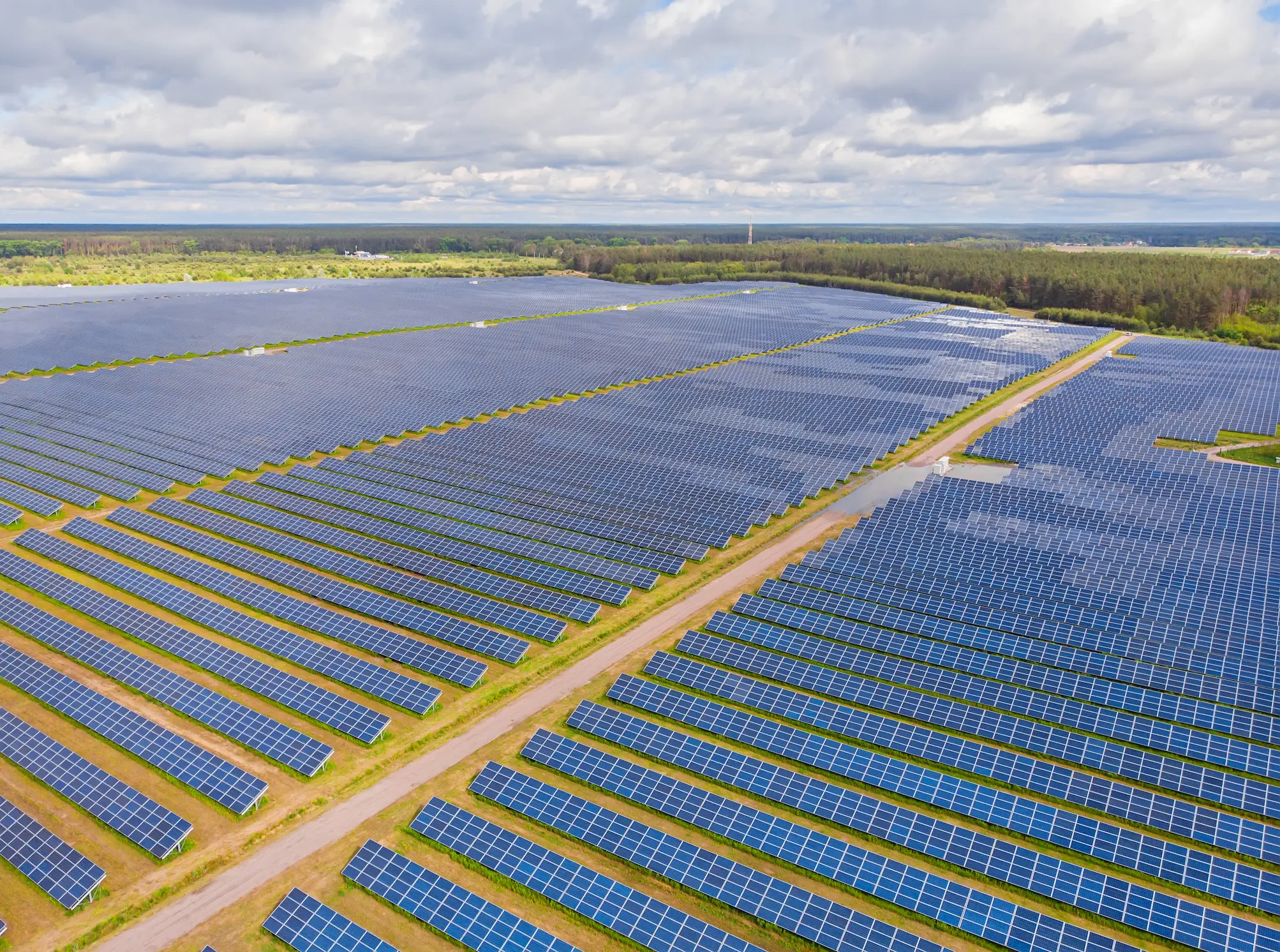
Fixed Mounting Structures: Require approximately 13,000 to 15,000 m² (1.3 to 1.5 hectares) of flat land per 1 MW capacity.
Smart Tracking Systems (Tatmaco Tech): Require 16,000 to 18,000 m² per MW to account for inter-row spacing and eliminate inter-panel shading during rotation. However, this configuration generates up to 35% more annual power, thoroughly justifying the additional footprint.
Technical Feasibility & Geographical Site Evaluation
Not every parcel of land is suited for solar deployment. To protect capital investment, the following criteria must be evaluated prior to site preparation:
GHI & DNI (Solar Irradiance): Analyzing multi-year satellite data to verify regional solar irradiation levels.
Ambient Temperature: Contrary to popular belief, extreme heat (above 45°C) degrades panel efficiency. Foothill regions with high solar radiation and moderate temperatures offer optimal yields.
Proximity to Substation/Grid: Shorter distances to grid connection points significantly reduce cabling and substation construction costs.
Soiling & Regional Wind Loads: Structural resilience against high winds and soil stability analysis for foundation piling.
The Core Infrastructure: Main Equipment Selection & Comparison
A solar station consists of four major equipment tiers whose technical integration defines total systemic efficiency:
A) Solar PV Modules
In modern utility-scale solar installations, older poly-crystalline technologies have been rendered obsolete by advanced modules:
Monocrystalline (PERC & N-Type): Offering high efficiency (>22%) and low annual degradation rates.
Bifacial Modules: Capturing direct sunlight from the front while absorbing ground-reflected light (Albedo) from the rear, boosting total yield by 5% to 15%.
B) Solar Inverters
Inverters convert DC output into grid-synchronized AC power. In modern engineering designs, String Inverters are preferred over Central Inverters due to simpler diagnostics, lower maintenance overhead, and multiple independent MPPT trackers.
Tatmaco’s Proprietary Innovation: Smart Solar Trackers
Traditional power plants employ fixed-tilt structures. Consequently, PV panels achieve perpendicular solar incidence only around noon. Leveraging 6 national and international patents, Tatmaco has commercialized next-generation Single-Axis and Dual-Axis Smart Solar Trackers.
Structural Comparison Matrix: Fixed vs. Tatmaco Smart Trackers
Fixed Structure: Static tilt | Base generation (100%) | Wind resistance up to 120 km/h | ROI in 4 to 5 years.
Tatmaco Single-Axis Tracker: East-West rotation | 25% to 30% Yield Increase | Auto-Stow mode in high winds | 5-Year Warranty + 20-Year Services | ROI in <3 years.
Tatmaco Dual-Axis Tracker: East-West + Seasonal elevation tracking | 30% to 35% Yield Increase | Auto-Stow mode | 5-Year Warranty + 20-Year Services | ROI in ~3 years.
Turnkey EPC Engineering and Execution Workflows
Proper execution by an experienced EPC contractor prevents electrical losses and long-term structural fatigue. Tatmaco’s EPC workflow follows 5 standardized steps:
EPC Steps 1 to 5
Civil & Foundation: Soil mechanics testing, ramming piles, or precast concrete foundations.
Structural & Tracker Assembly: Mounting hot-dip galvanized steel frames and smart drive actuators.
PV Array Installation & DC Cabling: UV-resistant solar cables and MC4 connectors engineered for <1% voltage drop.
Inverters & Substation Integration: Connecting DC runs to string inverters and step-up transformers for grid injection.
IoT & Smart Monitoring: Integrating weather stations (pyranometers, anemometers) with cloud monitoring portals.
Field References: Tatmaco Track Record & Tracked Projects
Bafq and Kal-Simin Power Projects: Successful utility installations engineered for extreme desert climates.
Solar Water Pumping Stations: Off-grid solutions replacing diesel engines with high-torque solar drives.
Financial Modeling & Return on Investment (ROI)
Investing in a solar power plant yields two main performance indicators: Energy Yield and Financial Yield.
A) Internal Rate of Return (IRR) & Break-Even Analysis
Due to annual PPA indexation, revenues scale alongside inflation rates. Integrating Tatmaco smart trackers increases annual energy generation by up to 35%, scaling revenues accordingly and shortening the payback period to under 3 years.
B) Capital Cash Flow Projection
Year 0 (CAPEX): Initial capital expenditure (Land, EPC, Equipment).
Years 1–3 (Break-even): Full recovery of initial invested capital.
Years 4–20 (Profit Phase): Annual net profit adjusted for inflation.
Years 21–25 (Extended Life): >80% linear performance output and net cash flows.
Operation & Maintenance (O&M) for 25-Year Performance
Routine Module Cleaning: Preventing up to 20% soiling losses via robotic or automated water-jet systems.
Drone Thermography Scanning: Annual aerial infrared inspections to locate and replace localized thermal hotspots.
Tracker Mechanical & Software Servicing: Bi-annual diagnostics of encoder sensors, drives, and gearboxes.
Frequently Asked Questions (FAQ)
How are equipment assets protected against extreme weather events
All solar stations deployed by Tatmaco are secured under comprehensive engineering risk insurance. Furthermore, Tatmaco smart trackers feature integrated anemometers that trigger an automatic Stow mode (horizontal lock) when wind speeds cross 80 km/h.
Are arid, non-arable, or saline lands suitable for solar power construction
Yes. Grade 3 and 4 non-arable agricultural parcels or saline flatlands unsuitable for farming represent prime locations for solar station land conversion.
What warranties apply to Tatmaco turnkey projects
PV modules carry a 25-year linear performance warranty, inverters include a 5-year replacement policy, and Tatmaco Smart Trackers are backed by a 5-year structural/motor warranty plus 20 years of spare parts availability.
What is the average timeline for securing bank financing and loans
Following land permits and PPA approvals, credit facility applications submitted to development banks or National Development Funds typically take between 3 to 6 months to disburse.